By David Zavada, Chief Marketing and Strategic Development Officer, and Sherry Weir, Partner, Kearney & Company
Key Takeaway
The Department of the Treasury’s (Treasury) move toward pre-payment verification will reshape how agencies manage funds. Chief Financial Officers (CFO) must prepare their organizations, processes, and controls to preferably avoid, but also handle payment holds and rejections.
The Impact of Improper Payments and Modernization Efforts
In fiscal year (FY) 2023, the Government Accountability Office (GAO) reported an estimated $236 billion in “improper payments.”1 Fraudulent and improper payments impact not only the availability of Federal funds for legitimate purposes, but potentially erode public trust and payment integrity. These losses are significant during normal times and can increase dramatically during emergencies.2 The reasons for these failures are inadequate controls, outdated systems that could not handle high volume, increasing sophistication of fraud schemes, and the inability of government agencies to share data. These issues have been reported by multiple sources, including the Inspector General community, GAO, and Congress.3
To address these challenges, several Executive Orders (EO) issued since January 2025 have focused on modernizing the payment infrastructure and using data analytics to enhance financial integrity. This modernization requires reliable, high-quality data to function efficiently. EO 14247, Modernizing Payments to and From America’s Bank Account, promotes operational efficiency by mandating the transition to electronic payments. EO 14249, Protecting America’s Bank Account Against Waste, Fraud, and Abuse, is directly aligned to EO 14247 and prompted the Office of Management and Budget (OMB) to issue Memorandum M-25-32, Preventing Improper Payments and Protecting Privacy Through Do Not Pay, to provide the Secretary of the Treasury with the authority to issue a four-year waiver of the Computer Matching Agreements (CMA) for the Do Not Pay (DNP) system, enabling streamlined data-sharing between agencies and Treasury. During FY 2024, the DNP system prevented, identified, or recovered $7.2 billion in fraud and improper payments.4
The CFO’s Challenge
On January 15, 2025, Treasury announced a historic step in addressing improper payments during a five-month pilot with the Social Security Administration’s (SSA) Full Death Master File (FDMF). The successful pilot paved the way for Congress to grant Treasury access to the FDMF beyond the December 2026 expiration date. This is just one example of additional data available through Treasury’s DNP system.
With congressional and Presidential action, Federal payments are entering a new era. Treasury’s real-time checks stop improper or fraudulent payments before the money goes out, shifting the payment model from “pay and chase” to “verify and release.”
CFOs Now Face Three Hard Truths:
- Pre-payment verification: Treasury will require cleaner (accurate, consistent, and reliable), richer (purpose, entity type, authority, associated txn id, risk attribute) data from every agency
- Rejected payments may rise: New checks will flag issues that once slipped through
- Processes could strain: If unprepared to handle holds or rejections, agencies could experience backlogs.
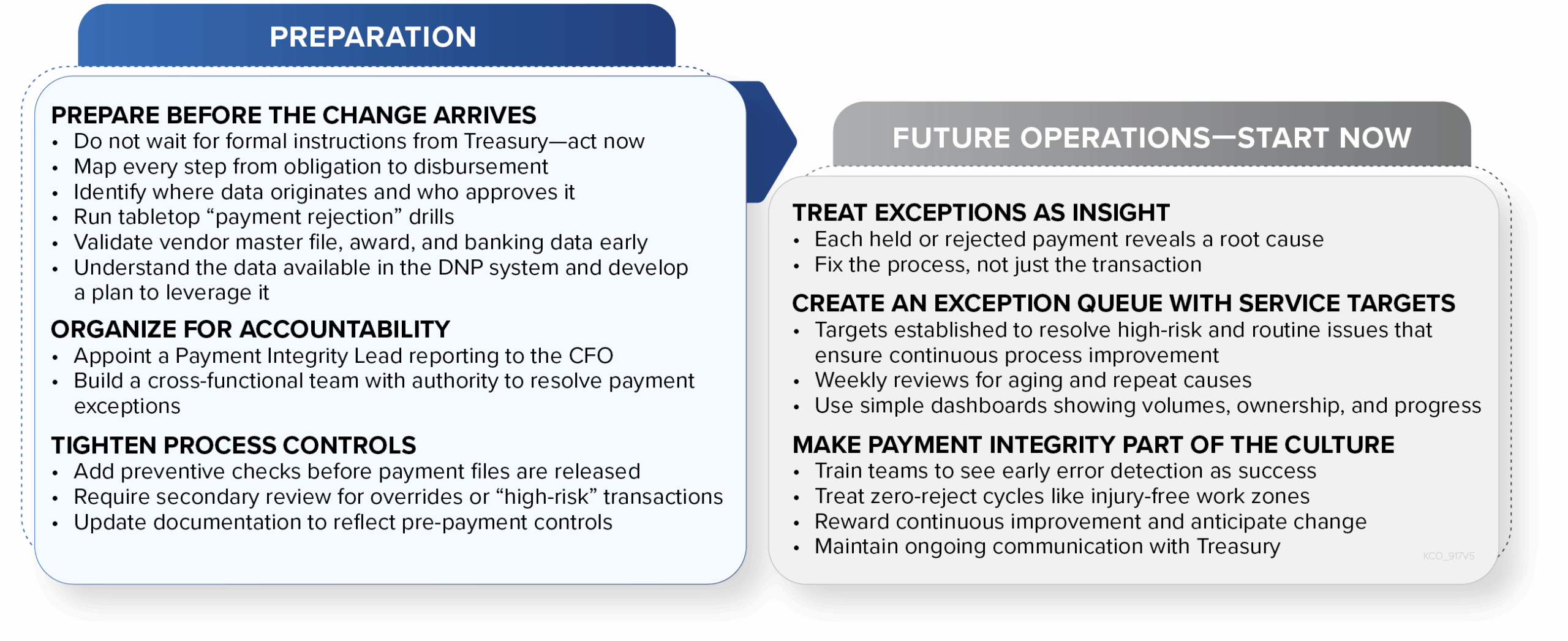
Bottom Line
Payment modernization will not wait for everyone to catch up. CFOs who create a strong, prepared organization will have fewer surprises, more robust control, and enhanced program integrity.
When pre-payment verification becomes standard, a prepared agency will be confident, ready, and trusted to get payments right the first time.
Connect with Us
This publication is for informational purposes only and does not constitute professional advice or services, or an endorsement of any kind.
Kearney & Company is a Certified Public Accounting (CPA) firm focused on providing accounting and consulting services to the Federal Government. For more information about Kearney, please visit us at www.kearneyco.com or contact us at (703) 931-5600.
Sources
1 https://www.gao.gov/blog/federal-government-made-236-billion-improper-payments-last-fiscal-year
2 https://www.gao.gov/assets/gao-06-844t-highlights.pdf
3 https://www.congress.gov/crs-product/R47902
4 Bureau of the Fiscal Service